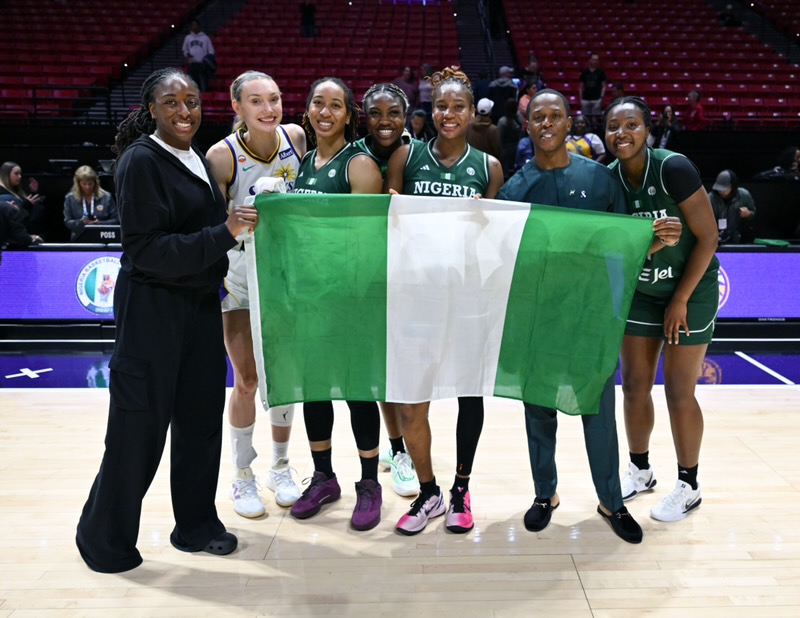
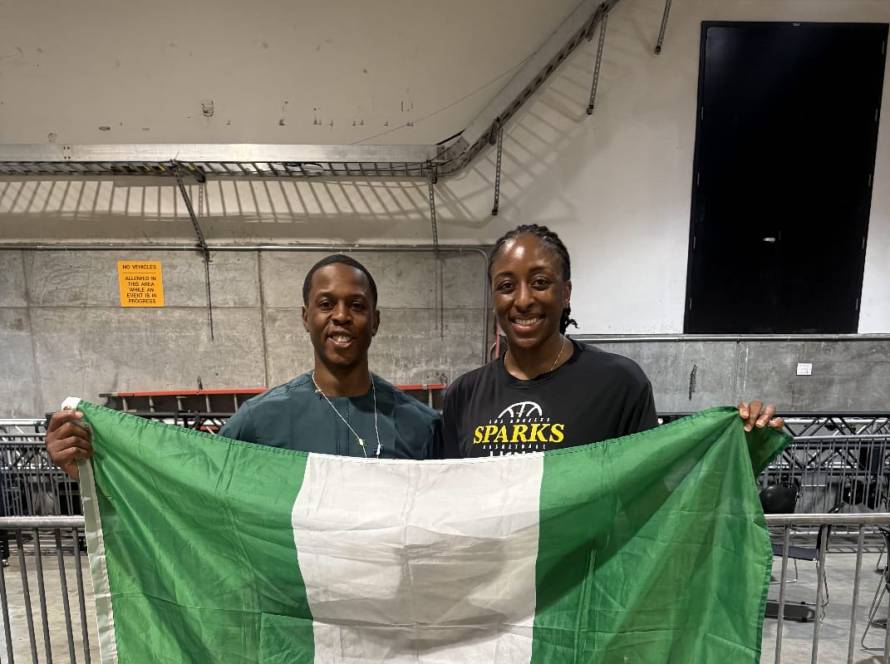
From courtside conversations in San Diego to a growing NBA draft pipeline, Nigeria Basketball is no longer chasing global relevance — it’s beginning to shape it.
By Chuka A. Erike
SAN DIEGO — The first sign came quietly.
Before the headlines. Before the official announcement. Before conversations around Olympic qualifiers, NBA relationships and diaspora talent pools became public, former NBA head coach David Fizdale sat courtside during Nigeria’s exhibition matchup against the Los Angeles Sparks in San Diego, observing a program already beginning to reflect something larger than a summer tour.
The moment felt like a rite of passage.
Like former Nigeria coach Mike Brown, Fizdale also played collegiately at the University of San Diego. Brown — now head coach of the New York Knicks and current coach of Nigerian star Ogugua “OG” Anunoby — previously helped guide Nigeria to one of the most significant moments in international basketball history: a 90-87 exhibition victory over Team USA ahead of the Tokyo Olympics, widely viewed as one of the greatest upsets the international game has seen.
What once felt improbable now feels increasingly possible: Nigeria Basketball is no longer simply trying to compete with the sport’s traditional powers — it is beginning to disrupt them.
Brown’s influence still appears deeply connected to the program’s direction. In announcing his decision, Fizdale credited Brown for helping initiate conversations surrounding the opportunity.
“Mike brought it up to me,” Fizdale said in a statement released by Nigeria Basketball. “After some good talks and going back-and-forth, we agreed that I was going to try to take the team to qualify.”
The connection matters. Brown helped elevate Nigeria Basketball’s credibility internationally, and now another NBA coach with league relationships and global visibility is being asked to continue building on that foundation.
And while D’Tigress were preparing to face WNBA competition in San Diego, Nigeria Basketball officials nearby appeared equally focused on something bigger: the federation’s long-term global vision.
Before tipoff, Nigerian Basketball Federation president Ahmadu Musa Kida and sponsorship and marketing committee chairman Ugo Udezue spoke courtside about the federation’s broader ambitions — strengthening NBA relationships, expanding Nigeria Basketball’s international visibility and continuing to elevate the country’s basketball profile globally.
Now that vision has a new face.
Nigeria officially hired Fizdale this week as head coach of D’Tigers, signaling an aggressive move toward deeper NBA influence, Olympic ambition and long-term program growth ahead of the 2028 Olympic Games in Los Angeles — Fizdale’s hometown.
But the hire represents more than a coaching change.
It reflects a federation increasingly positioning itself within the center of the modern global basketball conversation.
And perhaps nowhere was that momentum more visible than during D’Tigress’ recent U.S. exhibition tour.
The scoreboard rarely favored Nigeria during the stretch against WNBA teams. Rotations shifted. Key players were unavailable at times. Chemistry fluctuated. But within basketball circles surrounding the tour, conversations consistently moved beyond wins and losses.
“You look at them and they’re built like a WNBA roster,” veteran broadcaster Debbie Antonelli observed during Nigeria’s matchup against the Indiana Fever.
It was not said casually.
Nigeria’s women played with length, pace, physicality and defensive pressure that repeatedly drew attention throughout the tour. More importantly, they looked increasingly comfortable in environments that once felt distant from African basketball programs.
That evolution matters.
Because for years, Nigeria’s basketball potential existed largely as projection — a country rich in athletic talent, diaspora connections and untapped infrastructure. Today, however, the pieces are beginning to align visibly across both the men’s and women’s game.
On the women’s side, D’Tigress have become the standard-bearers for African basketball internationally. Under head coach Rena Wakama — who now also serves as an assistant coach with the Chicago Sky — the program reached the quarterfinals at the 2024 Olympics after already establishing itself as a dominant force in AfroBasket competition.
Beyond the national team itself, players of Nigerian heritage continue shaping the global women’s game at every level.
Nneka Ogwumike remains one of the defining figures in WNBA history. Arike Ogunbowale continues to rank among the league’s premier scorers. Ezi Magbegor has emerged as one of basketball’s elite defenders. Temi Fagbenle, Michaela Onyenwere and rising names such as Kiki Iriafen continue expanding that pipeline into the next generation.
And now Nigeria’s men appear positioned to follow a similar path.
Nigeria’s basketball momentum is no longer limited to the senior national teams alone. The pipeline continues expanding at nearly every level of the game.
Next week in Chicago, seven players of Nigerian heritage are expected to participate in the NBA Draft Combine, while three additional prospects are set to appear at the NBA G League Elite Camp — another reflection of the country’s growing influence within the global basketball ecosystem.
Among the names drawing significant attention is Ebuka Okorie, whose breakout freshman season at Stanford transformed him from an under-the-radar recruit into one of college basketball’s emerging guards. The Nigerian prospect earned All-ACC recognition after multiple explosive scoring performances and now enters the pre-draft process as part of a rapidly growing wave of Nigerian-linked talent rising through the American basketball system.
The visibility is no longer isolated.
It is layered.
Professional. Collegiate. Olympic. Global.
And with Fizdale now leading D’Tigers, Nigeria Basketball appears intent on connecting all of it together.
Fizdale arrives with NBA credibility, high-level player relationships and experience managing elite personalities — something that could prove critical if Nigeria eventually assembles the kind of roster many around the program envision.
Potential future player pools tied to Nigerian heritage could include Desmond Bane, OG Anunoby, Onyeka Okongwu, Gabe Vincent, Mark Williams, Zeke Nnaji, Precious Achiuwa, Josh Okogie, Adem Bona and Isaac Okoro — a reflection of just how expansive Nigeria’s basketball footprint has become internationally.
But talent alone has never been the question.
Structure has.
Continuity has.
Vision has.
That is why the symbolism surrounding Fizdale’s hiring matters as much as the résumé itself.
Nigeria Basketball is no longer operating solely as an underdog federation hoping to surprise larger countries in international play. Increasingly, the federation appears intent on building sustained relevance through NBA relationships, diaspora engagement, women’s basketball success and long-term Olympic ambition.
The women may have built the blueprint first.
Now the men are being asked to match it. And for a basketball nation whose influence already stretches far beyond its borders, that challenge may ultimately define the next era of Nigerian basketball.